Enamel
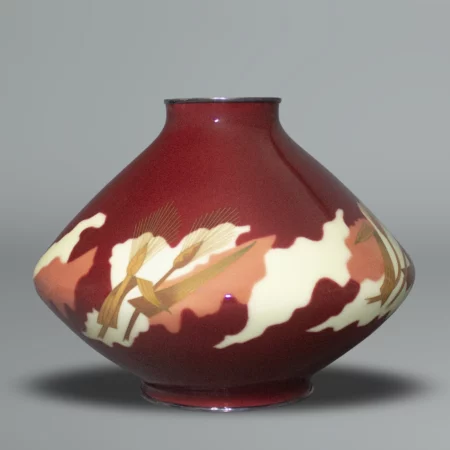
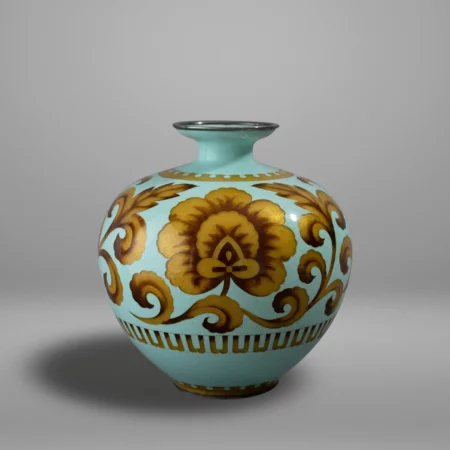
Japanese enamel, or shippō (literally “seven treasures”), is an art of extraordinary patience and precision. It requires the successive application of several layers of enamel, numerous firings, and a lengthy polishing process to achieve a brilliance unmatched by almost any other technique.
This art of fusing glass-like enamel onto metal saw a rapid rise and a true golden age during the Meiji era, driven in particular by the arrival of the German chemist Gottfried Wagner. Working with Japanese enamellers, Wagner introduced new chemical and technical knowledge that contributed to the development of translucent enamels of unprecedented quality. It was from this extraordinary creative ferment that the great figures of Meiji enamel emerged: Namikawa Yasuyuki, Namikawa Sōsuke, Hayashi Kodenji, Honda Tasaburō, and Andō Jūbei, whose workshop remains active today.
This exceptional art nearly disappeared, however. The considerable time and expertise required to produce a single piece struggled to find a place in a rapidly modernizing society, making production increasingly difficult to sustain economically. Yet the techniques were ultimately preserved and endured throughout the 20th century, embracing major artistic movements such as Art Deco. Today, a handful of artisans continue to keep them alive, bringing new and contemporary momentum to the art of Japanese enamel.
The main techniques of Japanese enamel
- Yūsen-shippō: the most traditional technique, in which fine metal wires outline the design before the spaces between them are filled with enamel. The wires remain visible after firing, giving structure and definition to the decoration.
- Musen-shippō: “wireless” enamel, in which the dividing wires are removed before the final firing, allowing for uninterrupted surfaces and soft, fluid gradations of colour.
- Moriage-shippō: raised enamel, in which successive layers of enamel are built up to create relief, volume, and depth.
- Shōtai-shippō: a technique related to Western plique-à-jour, in which translucent enamel is supported by a temporary metal substrate that is subsequently removed, leaving a delicate network of wires holding the enamel cells in place.
- Ginbari-shippō: a technique in which a thin sheet of silver is applied to the metal body, sometimes incised or hammered, and may incorporate a motif or decorative element that shows through beneath layers of translucent enamel.
Showing all 2 results